Steampunk Neon 3D Lettering
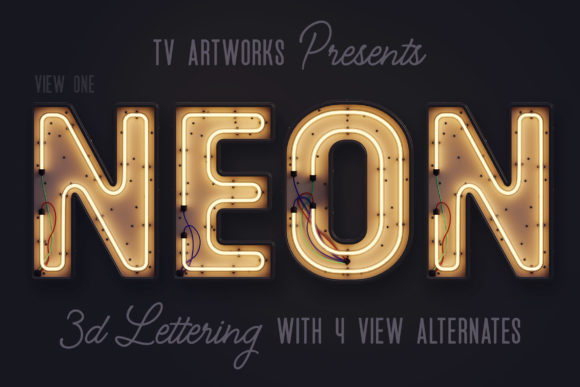
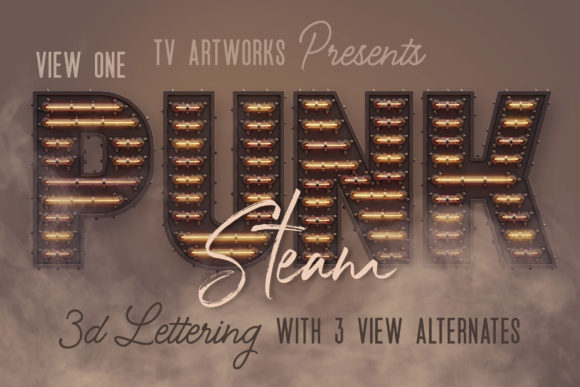
Steampunk Neon 3D Lettering is a visual design style that merges three distinct aesthetic traditions: the brass-and-gear motifs of steampunk, the luminous glow and saturated hues of neon signage, and the depth, shading, and perspective cues of 3D typography. It is not a software tool or a single font family, but rather a compositional approach—often realized through digital illustration, vector graphics, or 3D modeling software—that layers mechanical detailing (e.g., rivets, pipes, exposed cogs), ambient light effects (glows, halos, chromatic aberration), and dimensional rendering (extrusion, bevels, cast shadows) to produce letterforms with both tactile weight and futuristic nostalgia.
This style appeals most strongly to creators and organizations seeking a distinctive visual identity rooted in contrast: analog craftsmanship meets digital luminosity; historical imagination meets contemporary display technology. It is frequently used for event branding (music festivals, maker fairs), album art, game interfaces, boutique packaging, and immersive installations—contexts where atmosphere and thematic cohesion matter more than strict legibility at small sizes.
One key benefit of Steampunk Neon 3D Lettering lies in its narrative capacity. Unlike minimalist or geometric type treatments, it conveys layered meaning—industrial resilience, retro-futurism, inventive optimism—without relying on supporting text. When executed well, it functions as both typography and iconography, reinforcing brand personality while maintaining functional readability at appropriate scales. Its strong visual signature also supports memorability in crowded digital environments, such as social media feeds or app store thumbnails, where rapid recognition matters.
However, these strengths come with tradeoffs. Legibility can diminish significantly at smaller sizes or in low-contrast settings. The density of surface detail—gears overlapping letter counters, multiple light sources casting overlapping shadows—may obscure character shapes when scaled down below approximately 48 pixels or printed at under 12 pt. Additionally, production time and technical skill requirements are higher than for standard typographic treatments. Creating convincing Steampunk Neon 3D Lettering typically demands proficiency in at least one 3D application (e.g., Blender, Cinema 4D) or advanced layering techniques in vector or raster editors (e.g., Adobe Illustrator with 3D effects, Photoshop with smart objects and lighting layers).
Color use also requires careful consideration. While neon palettes often emphasize electric blues, hot pinks, and lime greens, steampunk’s earthy base tones (copper, oxidized bronze, sepia) must integrate without muddying the glow effect. Poorly balanced saturation or insufficient contrast between foreground lettering and background can result in visual fatigue or reduced accessibility—particularly for readers with color vision deficiencies. Designers should test output across devices and validate contrast ratios against WCAG 2.1 guidelines when the lettering serves functional text roles (e.g., navigation labels, call-to-action buttons).
Steampunk Neon 3D Lettering is a strong fit when the project goals prioritize mood, theme reinforcement, and high-impact visual presence over speed of execution or broad scalability. Examples include limited-run merchandise (T-shirts, posters, vinyl records), title sequences for short films or podcasts with a defined aesthetic, or experiential spaces (pop-up shops, themed bars) where environmental consistency enhances immersion. In these cases, the investment in custom lettering aligns with audience expectations and contextual intent.
Conversely, alternatives may be more appropriate when practical constraints dominate. For websites requiring responsive typography across devices, a carefully selected variable font with subtle steampunk-inspired weight or width variation—and optional neon-style CSS text-shadow applied selectively—offers greater flexibility and performance. Similarly, for UI components where clarity and speed of comprehension are critical (e.g., dashboard headers, mobile app menus), simplified steampunk-themed typefaces—such as Orbitron or Anton paired with strategic accent lighting—deliver stylistic resonance without compromising usability. In branding systems requiring extensive language support or multilingual implementation, fully custom 3D lettering becomes impractical; modular approaches using consistent texture libraries and lighting models across Latin, Cyrillic, or Greek character sets are more sustainable.
Another important consideration is longevity. Steampunk Neon 3D Lettering leans heavily on current rendering capabilities and display standards. As screen technologies evolve (e.g., microLED, higher dynamic range), today’s carefully tuned glow effects may appear oversaturated or flat on future hardware—especially if built using fixed raster assets rather than scalable vector or procedural shaders. Projects intended for multi-year use should weigh whether the style’s evocative power justifies potential obsolescence risk or whether a more adaptable foundation (e.g., parametric 3D models with editable material properties) better serves long-term maintenance needs.
Cost and collaboration dynamics also shape suitability. Commissioning custom Steampunk Neon 3D Lettering from a specialist illustrator or 3D artist typically involves higher upfront fees and longer revision cycles than licensing a pre-made font or using stock assets. Clients should clarify usage rights early—especially regarding derivative works, animation, or 3D printing applications—as many artists license static renders but retain rights to underlying geometry or texture maps. If internal teams lack 3D pipeline experience, allocating time for knowledge transfer or documentation becomes essential to avoid dependency bottlenecks.
For those evaluating whether Steampunk Neon 3D Lettering fits their needs, a practical starting point is to define the primary function of the lettering in context. Ask: Is it decorative (e.g., hero banner headline), functional (e.g., navigational label), or hybrid (e.g., logo that appears across both signage and app icons)? Next, map technical constraints: required sizes, output formats (print, web, video, AR), supported software, and accessibility obligations. Finally, assess alignment with broader brand attributes—is “inventive but grounded,” “analog-meets-digital,” or “playfully technical” central to how the audience should perceive the work?
If the answers point toward expressive impact, thematic consistency, and controlled deployment environments, Steampunk Neon 3D Lettering warrants serious consideration. If instead adaptability, speed, cross-platform reliability, or broad linguistic coverage are non-negotiable, then hybrid solutions—combining evocative steampunk textures with structurally sound, accessible typography—often yield more resilient outcomes. There is no universal “best” choice; only the option best matched to purpose, audience, and operational reality.
Ultimately, Steampunk Neon 3D Lettering is a specialized tool—not a default setting. Its value emerges not from novelty alone, but from deliberate alignment between aesthetic intention and practical execution. Readers evaluating this style should treat it less as a trend to adopt and more as a design decision to justify: one that earns its complexity through measurable contribution to communication goals.