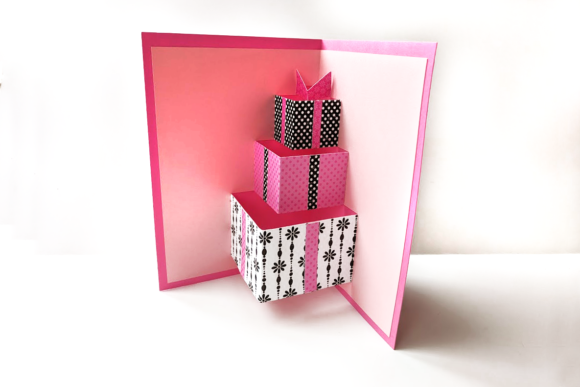
Gift Box Pop Up Card
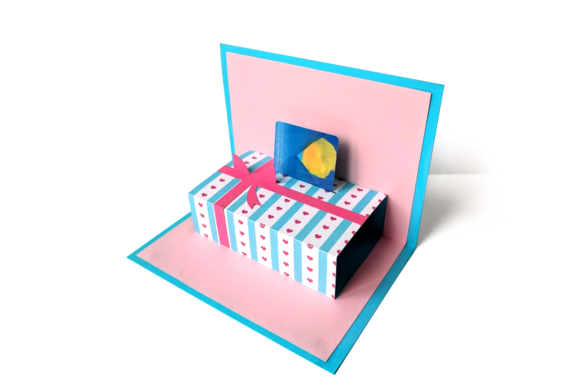
A Gift Box Pop Up Card is a three-dimensional paper craft that springs open to reveal a sculptural box—often layered, textured, and precisely engineered—when the card is opened. Unlike flat greeting cards or basic pop-ups, this design mimics the tactile surprise of unwrapping a real gift: hinges fold, sides rise, and a miniature box emerges from the page. Its appeal lies in its duality—it’s both functional (a card) and experiential (a moment of delight). For creators who value intentionality over ornamentation, it’s a rare format where structure, storytelling, and user interaction converge.
Why It Stands Out in a Digital-First World
In an age of instant messages and algorithm-driven feeds, the Gift Box Pop Up Card offers something increasingly rare: physical presence with purpose. It doesn’t just convey a message—it invites pause, touch, and attention. That makes it especially valuable for professionals whose work relies on resonance over reach: educators explaining spatial reasoning, marketers launching limited-edition products, or small business owners thanking loyal customers. The surprise isn’t gimmicky—it’s earned through craftsmanship. When folded shut, it looks like a clean, minimalist card. When opened, it delivers clarity, charm, and quiet confidence in execution.
Creative Possibilities Beyond Gifting
The Gift Box Pop Up Card adapts fluidly across contexts—not because it’s flexible in form, but because its logic is scalable and modular. Consider these grounded applications:
- Educators use it to model geometric concepts: students assemble versions with labeled faces, angles, or volume calculations—turning abstract math into tactile inquiry.
- Brands launching sustainable packaging embed seed paper inside the box layer, pairing the pop-up reveal with a tangible next step (plant the paper, grow herbs). The box becomes both metaphor and medium.
- Freelancers and designers send pitch decks as pop-up cards—each rising panel holds a project highlight, timeline, or testimonial. No PDFs. Just one focused, sequenced experience.
- Hobbyists and makers reinterpret it as a memory capsule: photos printed on box panels, handwritten notes tucked into hidden compartments, or fabric swatches glued to interior flaps.
Variations That Serve Real Needs
Not all Gift Box Pop Up Cards need intricate cuts or laser-cut precision. Simpler versions—cut by hand with a craft knife and scored with a bone folder—retain impact while lowering barriers to entry. Here’s how variation supports intention:
- Minimalist box: A single-layer white box with debossed logo and subtle foil stamp—ideal for luxury service providers wanting understated credibility.
- Modular box: Designed to hold interchangeable inserts—business cards, QR codes linking to portfolios, or tiny product samples—suited for creatives iterating across client projects.
- Interactive box: Includes pull-tabs that rotate inner layers or reveal hidden text when tugged—effective for storytellers, game designers, or workshop facilitators building engagement step-by-step.
- Recycled-material box: Built from post-consumer paper stock with visible fiber texture—used by eco-conscious brands to align material choice with mission without explanation.
How Different Audiences Apply It With Clarity
What makes the Gift Box Pop Up Card useful isn’t novelty—it’s fidelity to audience and goal. A blogger promoting a print-on-demand course might include a pop-up card in their welcome kit, with each rising panel representing a module: “Foundations,” “Tools,” “Case Study,” “Your Turn.” No bullet points. Just progression made physical. An educator teaching empathy might create a version where opening the box reveals mirrored surfaces—prompting reflection before reading a short prompt printed on the base.
Small business owners often underestimate how much trust a well-made physical artifact builds. A bakery sending thank-you cards after a wedding order can imprint the couple’s initials on the box lid and fill the interior with a tea bag and recipe card—transforming transactional gratitude into memorable continuity. The key is restraint: the box should amplify intent, not obscure it. If the goal is clarity, avoid decorative layers that compete with core content. If the goal is warmth, prioritize soft folds and natural materials over sharp edges and synthetic finishes.
Practical Tips for Consistent, Audience-Friendly Results
You don’t need advanced software to begin—but you do need systems. Start with consistency in scale: standardize your base card size (e.g., A6 folded to 105 × 148 mm) so templates, printing, and mailing remain predictable. Use vector tools like Inkscape (free) or Affinity Designer to draft hinge lines and fold marks—then test each iteration with scrap paper before committing to final stock.
When designing for others, always ask: What action should happen *after* the box opens? That question anchors every decision—from font size on interior panels (must be legible at arm’s length) to weight of paper (too light = floppy; too heavy = won’t spring cleanly). For educators, include a brief assembly guide on the back—not as instruction, but as invitation: “Try adjusting the height of the side panels. How does it change stability?”
For marketers, pair the physical card with a subtle digital echo: a unique URL printed inside the box, leading to a microsite with extended context—not a sales page, but a behind-the-scenes video of how the card was designed. That bridges formats without diluting either.
Keeping It Original Without Overcomplicating
Originality here isn’t about inventing new mechanics—it’s about matching form to function with honesty. A therapist mailing session summaries might use a Gift Box Pop Up Card where the box itself represents “containers for emotion,” with each panel holding a grounding technique. A publisher releasing poetry might let the box unfold slowly, revealing stanzas line-by-line as the reader lifts each flap—honoring rhythm over speed.
The strongest examples share one trait: they solve a small, real problem. Not “how do I stand out?” but “how do I help someone remember this idea?” or “how do I make gratitude feel tangible?” When the Gift Box Pop Up Card serves that quietly—without shouting, without excess—it earns attention the old-fashioned way: by being useful first, beautiful second.